
Marie Curie — The Woman Who Shone Brighter Than Silence
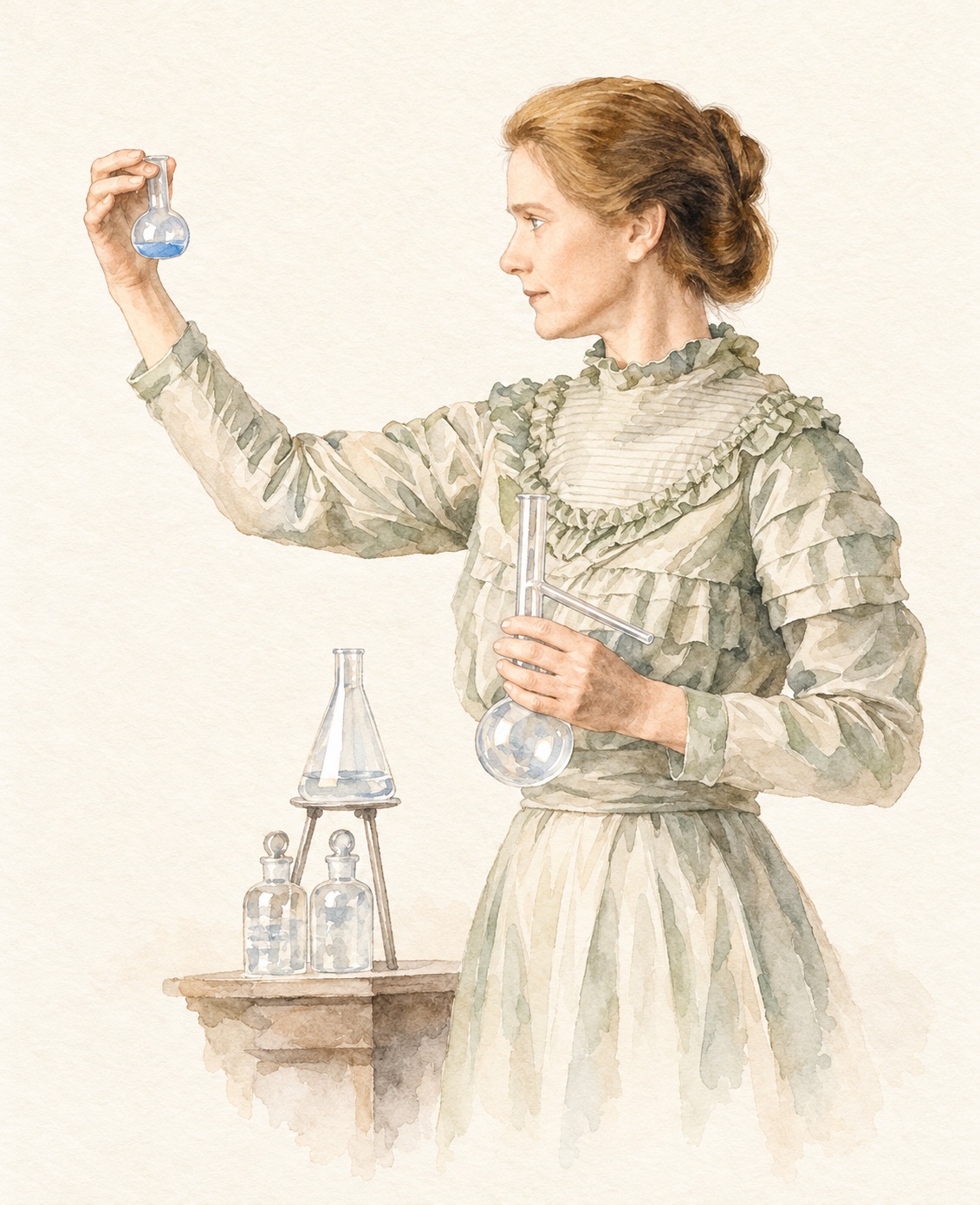
She was a woman. She was a foreigner. And yet she became the first person to win two Nobel Prizes in two different scientific fields.
Marie Curie never shouted to make herself heard. She worked, she persevered, and she let her discoveries speak for her.
What inspires me about her is her rigour, but above all her ability to break the ceilings that were placed above her head.
As a woman of colour, a mum and an educator, I see in her a model of quiet rebellion. A calm strength that changes the world.
Who was Marie Curie?
Let’s settle in as if we were having a coffee, and let me tell you her story.
Her name was first Maria Skłodowska. She was born in Warsaw in 1867, in a Poland that no longer existed on the maps, divided between neighbouring empires. At school, speaking Polish was forbidden. And for girls, the doors of the university stayed shut.
Maria was brilliant, but she had no money and no university within reach. So she made a pact with her sister Bronia: Maria would work as a governess to pay for her older sister’s medical studies in Paris, and then it would be her turn. She waited for years. Without ever letting go of her dream.
In 1891, at 24, she finally arrived in Paris and enrolled at the Sorbonne. A foreigner, in the midst of lecture halls almost entirely filled with men. She lived in a tiny room under the rooftops, sometimes eating only bread and tea, studying to the point of exhaustion. She earned a degree in physics, then a degree in mathematics. And she met Pierre Curie, a physicist who saw her as a colleague, not as an exception.
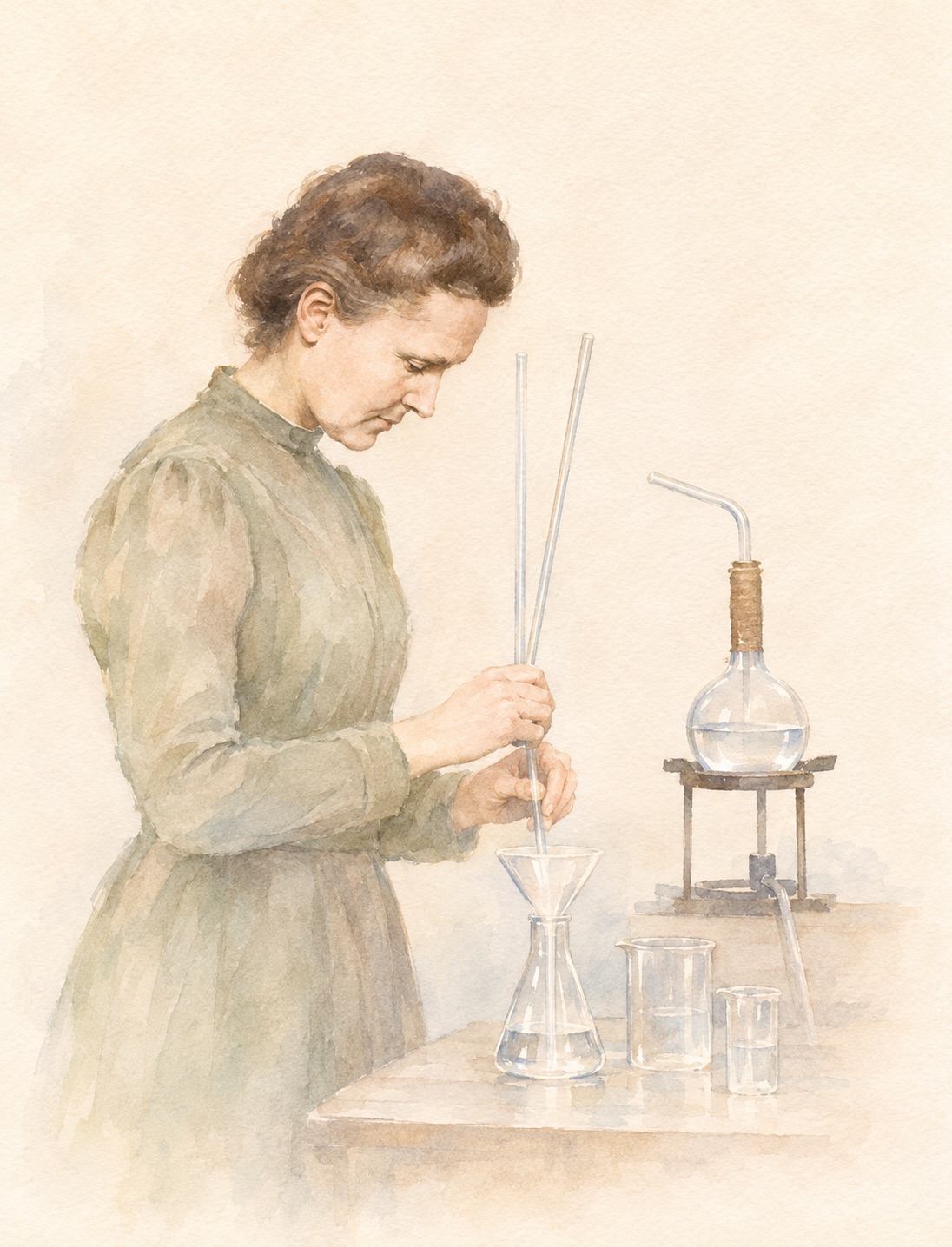
Together they set up in a poorly insulated shed, freezing in winter, stifling in summer. It was there that Marie, intrigued by the mysterious rays of uranium, coined the word “radioactivity”. In 1898, she discovered two new elements. The first she named polonium, in honour of her country, which no longer had a name on the map. The second: radium.
It would take her another four years, and tons of ore stirred by hand, to isolate a tiny amount. Four years of patience, in a shed that nobody envied.
In 1903, she received the Nobel Prize in Physics with Pierre Curie and Henri Becquerel. She was the first woman to win it. In 1906, Pierre died suddenly, knocked down by a horse-drawn carriage. Marie was a widow with two little girls. She did not fall apart: she took up his lectures and became the first woman to teach at the Sorbonne.
In 1911, she received a second Nobel Prize, this time in Chemistry, for the discovery of polonium and radium. No one had yet won two scientific Nobels. And to this day, no one has won a Nobel in two different scientific fields.
When science goes to the front
In 1914, war broke out. Marie Curie could have stayed safe in her laboratory. She chose to act.
She understood that X-rays could save lives by locating shrapnel and fractures in the wounded. So she fitted vehicles with radiology equipment, which came to be nicknamed “petites Curie” (“little Curies”), and sent them as close to the front as possible. She learned to drive herself. She trained women in radiology. Her daughter Irène, barely 17, worked at her side.
Hundreds of thousands of wounded soldiers were examined thanks to these units. This is what I call knowledge put at the service of others.
What her journey inspires in me
- The courage to train despite the obstacles, even if it means waiting for years.
- Quiet, determined work that doesn’t need to make noise to be immense.
- Calm strength in a world designed by and for men.
- The possibility of being a scientist AND a woman, a mother, an engaged person, without having to choose between the two.
“Nothing in life is to be feared, it is only to be understood.”
— Marie Curie
What I take away, for myself and for you
Marie Curie reminds me that…
- I don’t have to justify being ambitious.
- You can move forward without shouting, but without stepping back either.
- High standards are not the enemy of love.
- Being a woman of colour in a world with its own codes is possible… and powerful.
And you?
What does Marie Curie’s journey inspire in you? What is your own way of shining, even when you’re told it’s not your place?
Tell me in the comments, or share this article with a woman you admire.
You can shine without making a sound.
— Bouchra