
Educating for Peace: Maria Montessori’s Message, More Relevant Than Ever
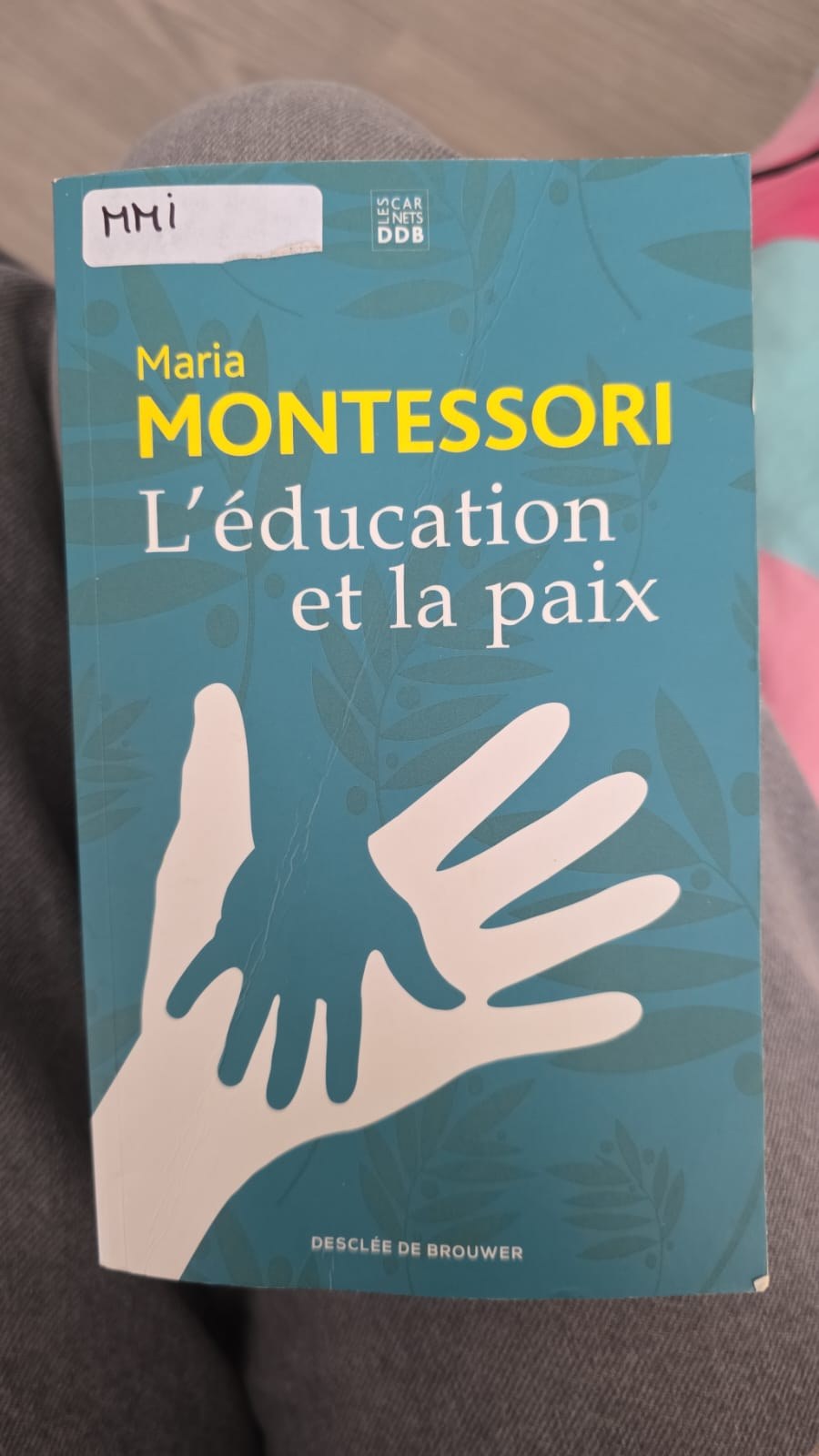
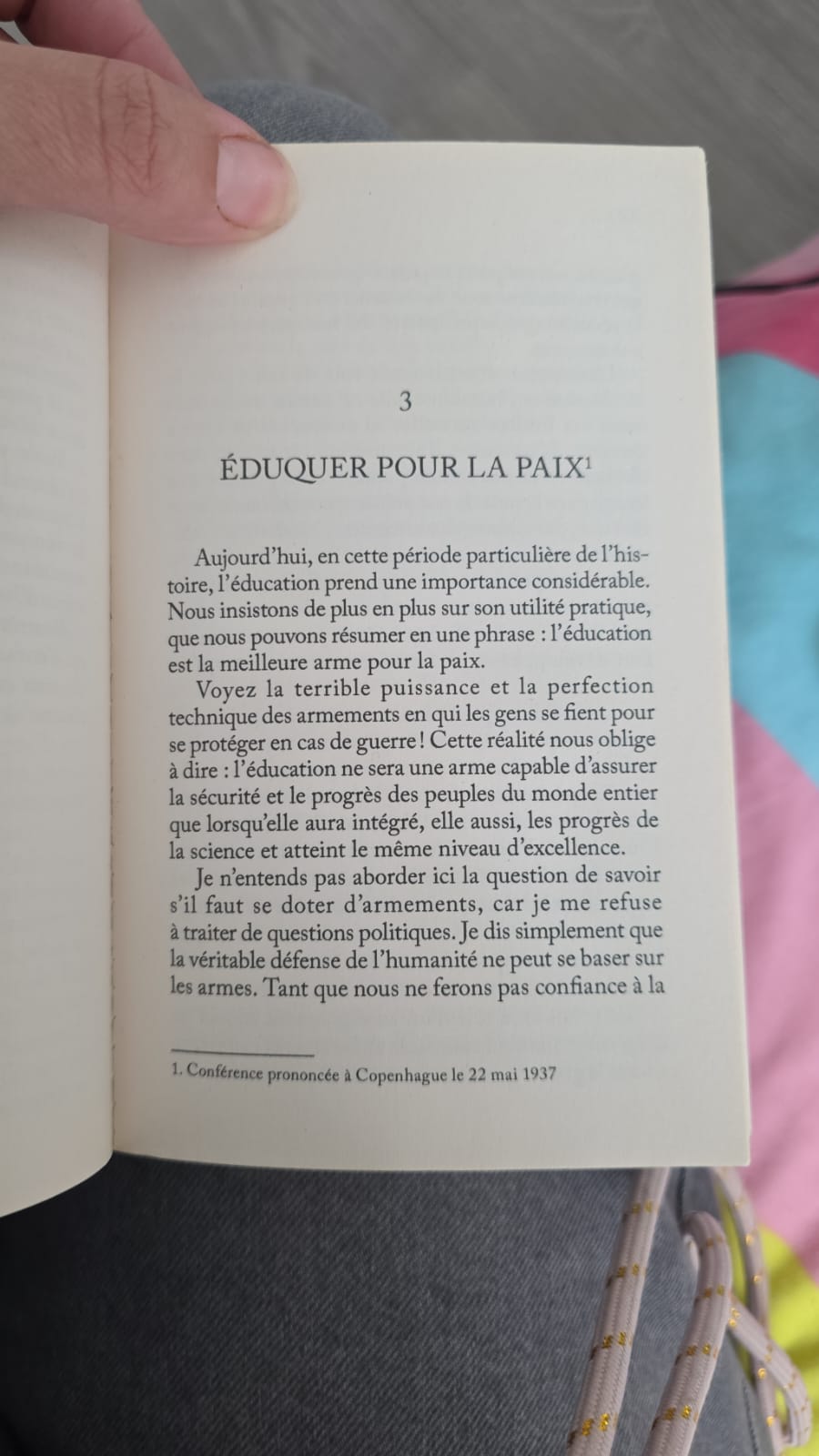
Extract from the chapter “Educating for Peace” by Maria Montessori: “education is the best weapon for peace”.
Education, the best weapon for peace
Today, in this particular period of History, education takes on considerable importance. We increasingly insist on its practical usefulness, which we can sum up in one sentence: education is the best weapon for peace.
Look at the terrible power and technical perfection of the weapons in which people trust to protect themselves in wartime! This reality forces us to say: education will only be a weapon capable of ensuring the security and progress of the peoples of the whole world once it too has absorbed the advances of science and reached the same level of excellence.
I do not intend to address here the question of whether weapons should be acquired, because I refuse to deal with political questions. I simply say that the true defence of humanity cannot be based on arms. As long as we do not place our trust in the great “weapon for peace” that is education, wars will keep following wars, and neither security nor human prosperity will be assured.
Since education is the only path of salvation for civilisation and humanity, it cannot remain confined within its current limits, nor keep its present form. Today’s education falls far short of the needs of our contemporaries. To use an image from the register of our concerns, one could say that, compared with modern weapons, education has remained at the level of the bow and arrow. How can we defend ourselves against the power of cannons and aerial bombardments with a bow and arrows? That is why we must develop and perfect this weapon that is education.
Avoiding war is not enough to build peace
It is obvious that education, the cornerstone of peace, cannot simply consist in trying to avoid children’s fascination with war. It is not enough to stop children playing with toy weapons, to stop teaching them the history of humanity as a succession of feats of arms, and to stop presenting victories won on battlefields as the supreme honour. It is not even enough to instil in them love and respect for all living beings and for everything people have built over the centuries.
That would be the role of a teaching entrusted with a far nobler task: campaigning against war itself. But this role we could call merely negative, since it is content to ward off the threat of an imminent conflict without making the positive efforts that are indispensable to bring about peace in the world.
Is it not obvious that wars cannot be avoided simply by this kind of education? If it were possible, how could we explain that in the past wars could not be avoided, despite the education provided by civilised society, which proclaims that human life and liberty are sacred, and despite the influence of religions, which have for thousands of years striven to teach people to love their brothers?
Men do not start wars because they are thirsty for blood or eager to use their weapons. They would rather not go to war, but they are drawn into it. All are terrified by the scourge of war, all would like to escape it, and it takes terrible moral and material constraints to force them to leave the safety of their homes and those dear to them.
Men do not take part in wars because, as children, they played with toy weapons. And teaching history based on memorising events and dates is certainly not the ideal method for making children long to become heroes.
A lost and disorganised humanity
It is clear that war is a complex phenomenon that we must analyse and understand, especially in our time. Humanity today is overwhelmed by events that affect the whole world and that education has not yet addressed. It is like a child left alone, lost in a forest, at the mercy of the slightest sound heard in the darkness.
Man does not understand the events that overwhelm him and is totally incapable of protecting himself against them. Society has evolved on a purely material level, putting in place immense mechanisms and creating sophisticated means of communication, but meanwhile humanity has remained ignorant and disorganised. Yes, the peoples of the world are disorganised and each individual thinks only of his own immediate well-being.
What school teaches the child
Education, as it is usually practised, encourages the individual to follow his own path and to care only about his personal interests. What does the child learn at school? Not to help others, not to whisper to classmates the answer they don’t know, and to care about only two things: at the end of the year, to be admitted to the next class and to win the prizes that will bring him victories in competition with his classmates.
And these children, having become poor little selfish beings, children whom psychology has proved to be mentally exhausted, find themselves later in life like grains of sand in the desert, with no ties to one another, isolated from their own neighbours and sterile. Let a storm come, and these tiny human particles, which have no spiritual generosity, will be caught in the gusts of the wind and turned into a deadly whirlwind!
An education capable of saving humanity
An education capable of saving humanity is no small matter. It involves the spiritual development of man and the strengthening of his personal worth. It means making young people capable of understanding the age in which they live.
What is the secret of such an education? Making man capable of mastering the mechanical environment that oppresses him today. Man, reduced today to being a producer, must become the master of production. Science and technology have increased its volume and made it a highly organised activity all over the world. It has therefore become necessary to use science to strengthen man’s inner dynamism and to organise humanity accordingly. Men can no longer remain ignorant of their own nature and of the world in which they live. The true scourge that threatens them today is precisely this kind of ignorance.
We must organise our efforts for peace and prepare it scientifically through an education that points us to the new world to be conquered: that of the human mind.

The child, a hope and a promise
In our own experience with children, we have observed that the human young is a spiritual embryo, endowed with a mysterious sensitivity that guides him and a creative dynamism whose purpose is to build in his soul a kind of marvellous instrument. Like a radio set able to receive short or long waves transmitted through space, the instrument the child gradually builds in his soul is destined to receive the sacred waves that carry divine love through infinite spheres and eternity. And it is this receptivity that gives man his unique worth: man is great because he can receive the emanations of the Divine.
The child, capable of developing, is tangible proof of the possibility of a better humanity. In him we have been able to perceive the process by which the normal human being is built. We have seen children change completely, acquire a love of objects and develop within themselves a sense of order and discipline and perfect composure in the face of circumstances, in response to the total freedom granted to them. We have seen them work steadily, relying on their own dynamism and developing it through their work.
The child is, for humanity, both a hope and a promise. By caring for this embryo as our most precious treasure, we shall work to make humanity grow. The Men we educate in this way will be able to use their divine power to surpass the Men of today who have entrusted their fate to machines. What we need above all is faith in the greatness and superiority of Man. Since men have succeeded in mastering the cosmic energies that cross the atmosphere, they will surely come to understand that the fire of genius, the insight of intelligence and the light of conscience are also energies that must be organised, valued and used for the progress of social life.
When the adult does not understand the child
Today, these energies are scattered, or rather repressed and led astray, because of the errors perpetuated by the kind of education that still holds the world under its sway. The adult does not understand the child. Parents, unconsciously, fight against their children instead of helping them in their divine mission. Fathers and sons do not understand each other. A chasm separates them from the child’s birth. And this lack of understanding causes Man’s downfall. It saddens his spirit, leads him astray, impoverishes him and prevents him from realising his potential.
The adult’s lack of understanding towards children carries within it the tragedy of the human heart, which later shows itself in insensitivity, laziness, even criminality. Those who have been humiliated are ashamed of themselves; the shy withdraw into their shell; the fearful seek their personal comfort. The entire potential richness of the human personality is reduced to nothing.
Preparing for peace from childhood
Education must make use of the value of the secret instincts that guide Man in building his own life. Our experience has shown us that if children and adolescents do not have the chance to engage in a real social life, they develop neither their moral sense nor their sense of discipline. In that case, these virtues are only the result of training, of imposed constraint, and not manifestations of freedom.
The human personality is formed through continual experience. It is up to us to create, for children, adolescents and young people, an environment, a world that allows these formative experiences. The young person’s personality should be brought into contact with the world of production only after an apprenticeship through experience. Young people must first be guided towards an awareness of their responsibilities towards social organisation. From earliest childhood, the human being must have concrete experience of association; only afterwards can he gradually discover the secrets of society’s technical evolution.
Today, we have an organisation of machines. What is needed are Men capable of using machines to carry out the high mission of which each of them will be aware and for which each will feel responsible.
It is absolutely certain that the secret of Man’s future power remains buried within him during his development, that it lies in the hearts of the young.
Those who prepare for war, those who want peace
The countries that want war have succeeded in discovering the powers hidden in children and young people, in giving them their full dimension, in organising them socially and in making them an active force in society to serve their interests. And here lies our tragedy: until now, these truths have been recognised only by the powers that prepare for war.
But a true and powerful organisation of humanity cannot be improvised overnight. This is a fact of great practical importance. The groundwork needed for such an organisation must begin in childhood, at the very start of life. In short, society can only be organised if education offers the human being a series of progressive social experiences as he passes from one stage of his life to the next.
The countries that want war prepare young people for war, but those who want peace have neglected children and adolescents, because they are incapable of organising themselves for peace.
Peace, a universal principle
Peace is a practical principle of human civilisation and social organisation that is founded on the very nature of Man. Peace does not enslave Man; on the contrary, it makes him aware of his power over the universe. And because it is founded on human nature, it is a universal and constant principle that applies to every human being. This is the principle that must guide us in developing a science of peace and in educating Men for peace.
— Maria Montessori